
Kerala has long been known for its high life expectancy, strong healthcare system, and quality of life. Today, however, it faces a new challenge, one that many developed nations are already grappling with.
Kerala is becoming India’s oldest state.
According to population projections, nearly one in every five Keralites is already a senior citizen, and by 2036, almost one in four people in the state will be above the age of 60.
This demographic transformation is unprecedented.
The question is no longer:
“How do we help people live longer?”
The real question is:
“How do we help people live better while growing older?”
For many seniors, the answer is simple.
They want to remain in their own homes.
They want to stay connected to their communities.
They want independence without isolation.
This concept is known globally as “Aging in Place.”
And Kerala may become India’s most important testbed for it.
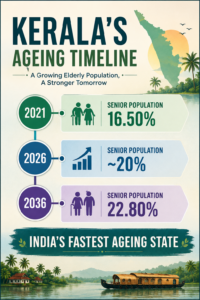
Kerala’s success story has created an unexpected challenge.
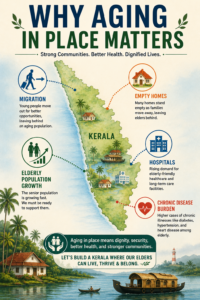
People are living longer.
Families are becoming smaller.
Children are increasingly working in other cities and countries.
Traditional caregiving structures are under pressure.
Many seniors today live:
At the same time, healthcare needs are increasing.
The state is seeing rising cases of:
A single fall inside the home can often become the turning point that forces a senior citizen into institutional care.
The challenge isn’t just medical.
It is emotional.
It is social.
And increasingly, it is economic.

Kerala already has several strong initiatives.
Programs such as:
have created a strong foundation for elder care.
However, the scale of ageing expected over the next decade will require new approaches.
The future cannot depend solely on more hospitals, more caregivers, or more nursing homes.
The future requires intelligence embedded directly into care.
This is where Artificial Intelligence becomes transformative.

Falls are among the biggest reasons seniors lose independence.
Modern AI systems can now use:
to detect falls instantly.
The moment a fall occurs:
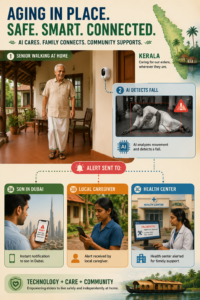
Instead of discovering an accident hours later, help can arrive within minutes.
Imagine a diabetic patient in Alappuzha.
A smartwatch continuously tracks:
AI analyzes these patterns.
Instead of waiting for a medical emergency, doctors receive early warning signals.
This shifts healthcare from:
Reactive → Predictive

Technology often fails seniors because it is not built for them.
Many applications assume:
AI can change that.
Powered by initiatives like India’s language AI ecosystem and Malayalam speech technologies, future assistants could naturally communicate in Malayalam.
Imagine saying:
“എന്റെ മരുന്ന് എപ്പോഴാണ് കഴിക്കേണ്ടത്?”
And receiving a personalized response instantly.
No app navigation.
No typing.
Just conversation.
Loneliness is emerging as one of the largest health risks among older adults.
AI companions can:
These systems do not replace family.
They fill the gaps between human interactions.
The future home itself becomes a caregiver.
AI-enabled homes can:
The home becomes aware.
Not intrusive.
Supportive.
One of the most exciting developments in healthcare AI is the concept of a Digital Twin.
A digital twin is a virtual representation of a person’s health.
Using:
AI can simulate health risks before they happen.
This could enable:
before symptoms become severe.
The next generation of AI systems will not simply answer questions.
They will take action.
Future agentic AI systems could:
acting as a personal care coordinator for every senior citizen.
What Can Kerala Learn From Japan?
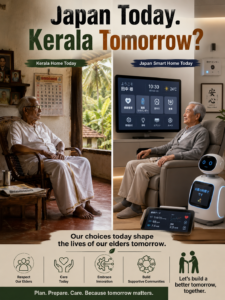
Japan is one of the world’s oldest societies.
More than 29% of its population is above the age of 65.
Faced with a shrinking workforce and growing elderly population, Japan has spent decades investing in technologies that help seniors live independently while maintaining dignity and happiness.
Some examples include:
Homes equipped with sensors that detect falls, inactivity, or unusual behaviour.
Robots such as PARO and Lovot provide companionship, emotional engagement, and cognitive stimulation.
Wearables and remote monitoring systems help doctors intervene before health conditions worsen.
AI-powered wheelchairs and navigation systems help seniors remain mobile and independent.
The result is not simply better healthcare.
The goal is greater wellbeing, social participation, and happiness.
Kerala does not need to copy Japan.
But it can adapt the lessons to its own culture, language, and community-based care model.
When discussing ageing, the conversation often focuses on:
But older adults often define quality of life differently.
Research consistently shows that seniors value:
more than technology itself.
AI is valuable only if it helps achieve these outcomes.
A fall detection system is not really about sensors.
It is about peace of mind.
A Malayalam voice assistant is not about artificial intelligence.
It is about reducing frustration.
Remote health monitoring is not about data.
It is about confidence.
The true measure of success is simple:
Can seniors remain happier, healthier, and more connected to the people and places they love?
If the answer is yes, then technology is doing its job.
The next generation of elder-care robotics is increasingly being powered by AI platforms from companies such as NVIDIA. Through technologies like NVIDIA Isaac for robotics, edge AI computing, computer vision, and digital twins, developers are building intelligent robots capable of assisting seniors with daily activities, monitoring safety, detecting falls, providing companionship, and supporting caregivers. These systems can understand voice commands, navigate homes autonomously, recognize emergencies, and even adapt to the preferences and routines of individual users.
For ageing societies such as Japan, robotics has become an important tool for addressing caregiver shortages while helping seniors maintain independence. As Kerala’s elderly population continues to grow, similar AI-powered robotics solutions could support home-based care, remote monitoring, mobility assistance, and social engagement. While robots will never replace human care, they can augment caregivers and help older adults live safer, more connected, and more independent lives.
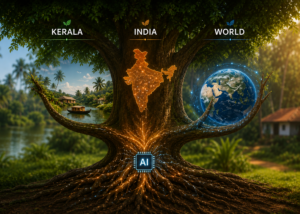
Kerala possesses unique strengths:
✔ Strong healthcare infrastructure
✔ Active local governance
✔ World-renowned palliative care model
✔ High digital literacy
✔ Growing startup ecosystem
✔ Progressive social policies
These strengths create an opportunity to build the world’s most advanced Aging-in-Place ecosystem.
Not imported from elsewhere.
Built in Kerala.
For Kerala.
And eventually scaled across India.
Kerala’s Dedicated Department for Senior Citizens
Kerala’s recent decision to establish a dedicated department for senior citizens reflects the growing importance of ageing as a public policy priority. As India’s fastest-ageing state, Kerala is witnessing a significant rise in its elderly population, bringing new challenges related to healthcare, caregiving, social isolation, mobility, and long-term support. The new department signals a shift from treating elderly welfare as a fragmented responsibility to addressing it through a coordinated and focused approach.
The real significance of this move lies in its long-term vision. Beyond healthcare, the department can help strengthen home-based care, social inclusion, mental wellbeing, age-friendly infrastructure, and support services that allow seniors to remain independent for longer. Combined with community programs such as Vayomithram and emerging AI-enabled care solutions, this initiative can help Kerala build a future where ageing is not simply about living longer, but about living healthier, safer, more connected, and ultimately happier lives.
The future of aging is not about building more institutions.
It is about helping people remain where they most want to be:
At home.
Safe.
Connected.
Independent.
Dignified.
Kerala is aging faster than any other Indian state.
That challenge can become Kerala’s greatest innovation opportunity.
If we design AI thoughtfully, responsibly, and inclusively, Kerala can become a global model for how technology empowers people not just to live longer but to live better.
The future of Aging in Place may not begin in Silicon Valley. It may begin in Kerala.