

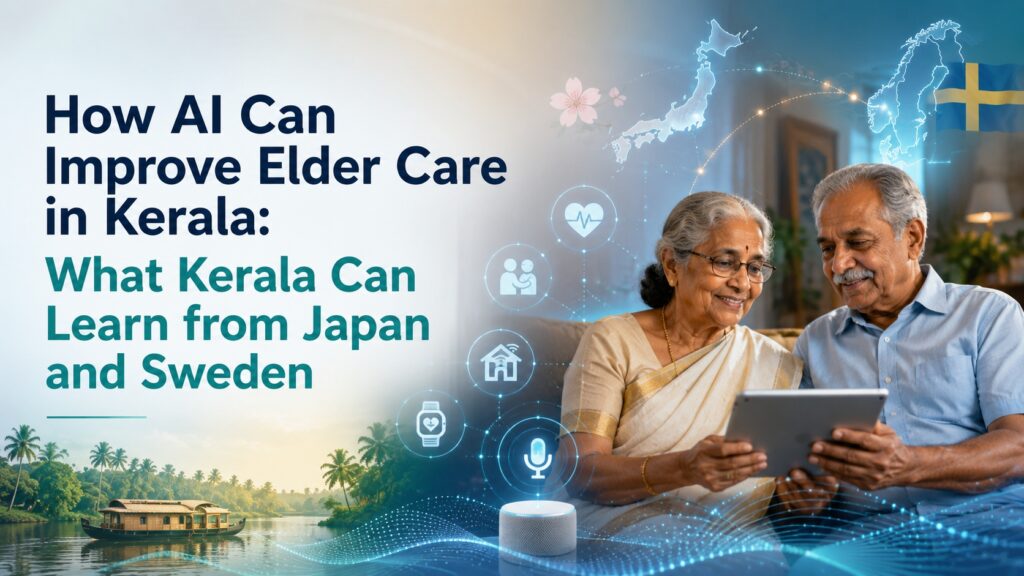
Consider a situation that is becoming increasingly familiar in Kerala. An older adult continues to live independently while their children work in another state or abroad. The family calls regularly, a neighbour checks occasionally and a local healthcare worker may visit when required. However, no one immediately notices a missed medicine, an unusual change in movement, a minor fall, increasing confusion or several days of social withdrawal.
The problem is not always the complete absence of care. It is the gap between routine independence and the moment when professional help becomes necessary.
Artificial intelligence could help close this gap. AI-supported sensors can identify unusual movement, digital tools can support medicine adherence, screening systems can flag possible cognitive decline and connected-care platforms can help families, nurses and doctors respond earlier.
Kerala does not have to build this model from the beginning. Japan and Sweden are already testing and implementing different forms of AI-supported eldercare. Japan is combining care technology, predictive systems and advanced robotics, while Sweden is focusing on preventive monitoring, responsible data use and AI integration within public healthcare.
The most useful path for Kerala lies in understanding what is already practical, what is still experimental and what must be adapted to local conditions.
Why does Kerala need an AI-supported eldercare model?
Kerala is undergoing one of India’s most advanced demographic transitions. The state’s Vision 2031 initiative projects that more than one-fifth of Kerala’s population could be aged 60 or above by 2031. Low fertility, increased life expectancy and the migration of working-age people are contributing to growing healthcare, caregiving and social-inclusion challenges.
This change will affect more than hospitals and old-age homes. It will influence primary healthcare, palliative care, emergency response, local self-government, housing design, transportation and the ability of older adults to remain safely in their own homes.
Kerala has already established an important policy foundation. The Kerala State Policy for Senior Citizens 2026 was approved in March 2026, and the state subsequently constituted a dedicated Senior Citizen Welfare Department in May 2026.
The state also has human-service networks on which technology can be built. Vayomithram provides mobile clinics, medicines, palliative care and help-desk support. Sallapam connects isolated older adults with younger telephone companions. Elderline 14567 provides information, emotional support and field intervention, while the state has also approved Rapid Response Teams for senior citizens.
How can AI help older adults?
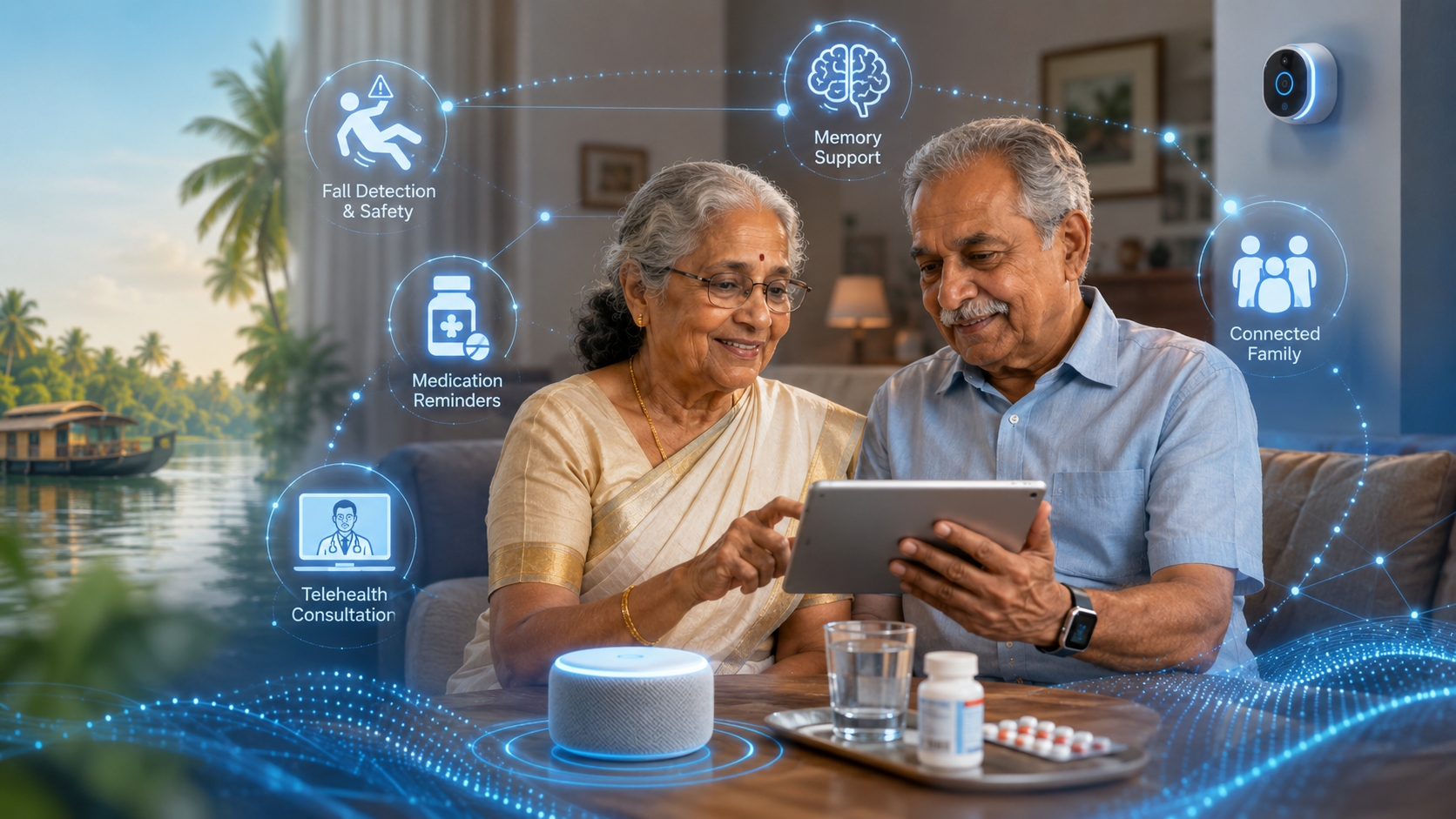
AI can help eldercare in five practical ways:
- Detecting falls and unusual changes in movement.
- Supporting medicine adherence and chronic-disease monitoring.
- Identifying possible cognitive decline earlier.
- Reducing the documentation and coordination burden on caregivers.
- Connecting an alert to the right family member, nurse, doctor or emergency service.
The most important word is support. AI should identify patterns, prioritise attention and organise information. It should not independently diagnose an illness, change medication or make critical welfare decisions.
Japan and Sweden are beginning to demonstrate how this distinction can work in practice.
What is Japan doing with AI in eldercare?
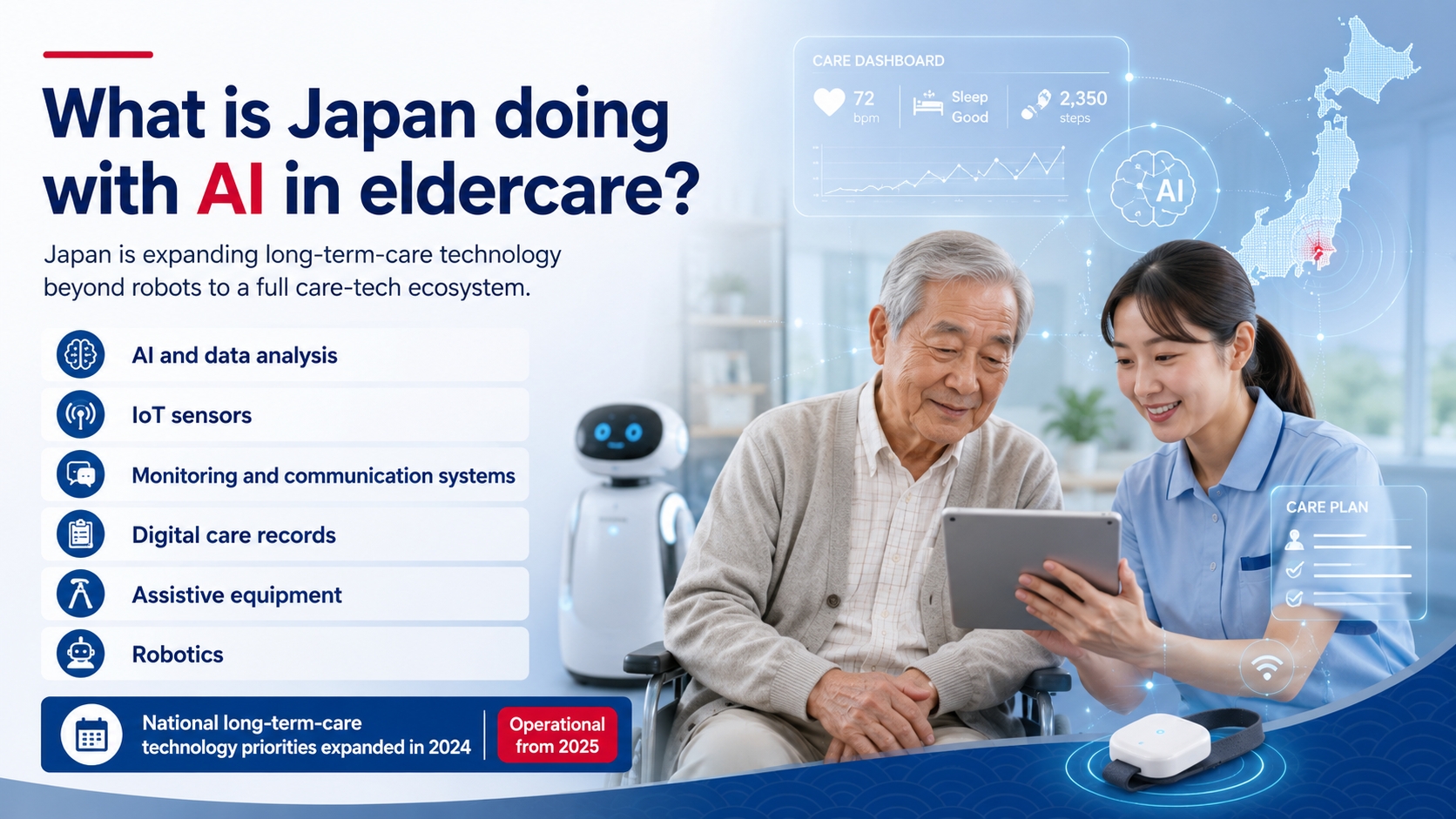
Japan’s recent approach is broader than the familiar image of a robot assisting an older person. Its current policy increasingly treats sensors, data platforms, communication systems, predictive software and care-management tools as part of a larger care-technology ecosystem.
Japan has expanded its national long-term-care technology priorities
In June 2024, Japan’s Ministry of Economy, Trade and Industry and Ministry of Health, Labour and Welfare revised the country’s official priority areas for long-term-care technology. The revised framework became operational in April 2025.
It now covers nine areas and 16 individual categories. New priorities include functional-exercise support, eating and nutrition management, and daily-living and care support for people with dementia. Existing categories covering home monitoring, facility monitoring, communication, toileting, bathing, transfers and care-work support were also revised.
This policy shift is significant because it moves the discussion away from robots alone. Japan is treating eldercare technology as a combination of:
- AI and data analysis
- Internet of Things sensors
- Monitoring and communication systems
- Digital care records
- Assistive equipment
- Robotics
The goal is to improve care quality, support the independence of older adults and reduce the physical and administrative burden on care workers.
For Kerala, this is an important starting lesson. AI for eldercare should not be planned as a single product. It should be treated as a coordinated layer across home care, hospitals, social services and emergency response.
AI is making cognitive screening faster and more accessible
One of Japan’s most relevant recent developments is an eye-tracking cognitive assessment created by researchers associated with Osaka University.
The system uses a tablet’s front-facing camera and gaze-analysis algorithms. The person watches a short cognitive-task video, and the software analyses eye movements associated with memory, attention, judgment, spatial cognition and orientation. The assessment can be completed in approximately three minutes.
The application received regulatory approval as Software as a Medical Device in 2023. In January 2025, it became the first eye-tracking dementia solution covered by Japan’s public health insurance. The Japan Science and Technology Agency reported in 2026 that the system was being used in clinical practice at medical institutions across Japan.
This technology does not replace a physician’s diagnosis. Its value lies in making preliminary cognitive assessment faster and less dependent on lengthy interviews.
That could be particularly relevant to Kerala. Tablet-based cognitive screening could eventually be evaluated for use through:
- Primary health centres
- Vayomithram mobile clinics
- Geriatric outpatient departments
- Community health camps
- Assisted-living facilities
Because the assessment relies heavily on visual tasks, the developers state that it is less affected by language differences and hearing loss than conventional interview-based tests. A Kerala pilot would still require clinical validation, regulatory review and testing with local populations before deployment.
Japan is testing AI care plans, voice documentation and digital twins
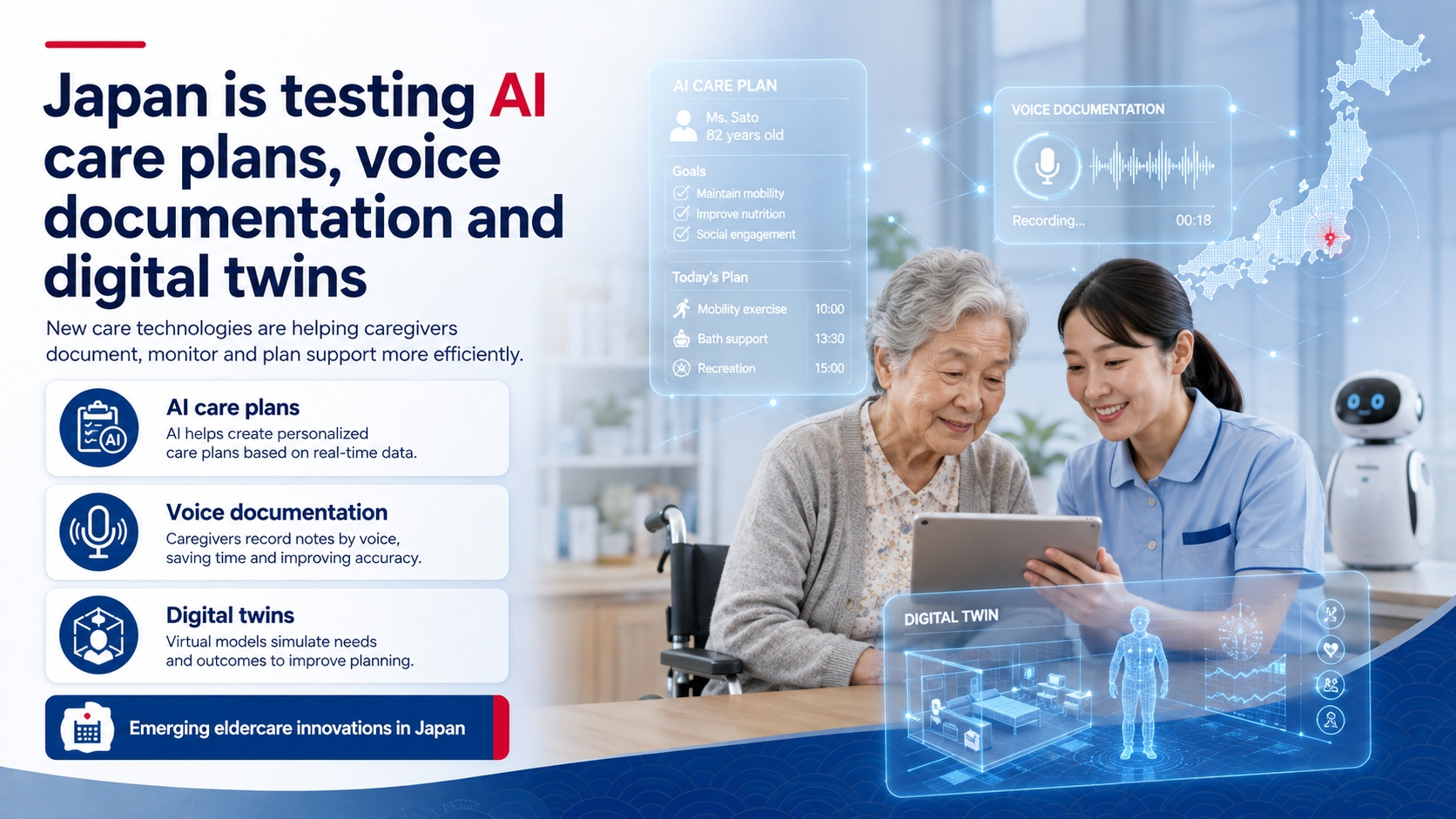
Japan’s Agency for Medical Research and Development lists several current care-technology research and evidence-building projects for 2025 and 2026.
These include voice-AI platforms for care documentation, data-based AI support for creating care plans, multimodal AI for identifying mobility-related risks and integrated monitoring systems combining alerts, communication and business-intelligence tools.
Other active projects include a dementia-focused monitoring robot designed around a digital twin of the care environment, sensing systems for assessing changes in an older person’s condition and a sensor-based system intended to predict urination needs.
These initiatives are important, but they must be described accurately. Many are still research, development or evidence-building projects rather than technologies already proven at nationwide scale.
Advanced care robots remain a longer-term opportunity
Waseda University’s AIREC project represents the more advanced end of Japan’s eldercare innovation.
AIREC stands for AI-driven Robot for Embrace and Care. The humanoid system is being developed to learn complex tasks and support household activities, caregiving and medical assistance. It forms part of Japan’s government-supported Moonshot Research and Development Programme.
Research demonstrations include assistance with tasks such as putting on socks and developing safe physical interaction with people. However, Waseda University describes AIREC as currently under development.
Kerala should therefore view humanoid caregiving robots as a future research and specialised-care opportunity—not the first step in its eldercare strategy.
More immediate value can come from simpler technologies such as movement sensors, voice-assisted documentation, medicine support and connected alerts.
What is Sweden doing differently?
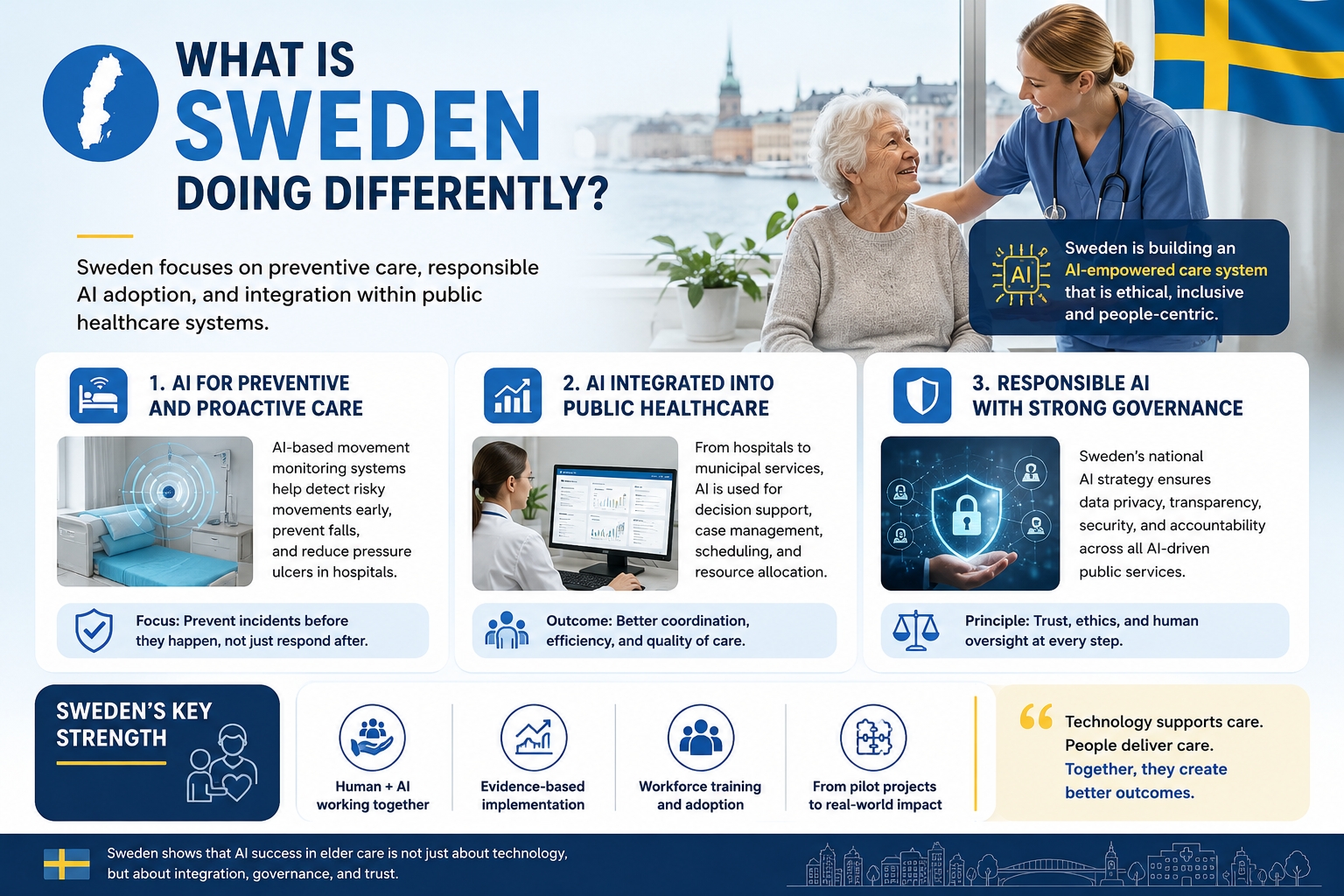
Sweden’s approach is less focused on highly visible humanoid robots. Its strongest lesson is how AI can be integrated into healthcare operations, public institutions and staff workflows.
AI-supported movement monitoring is helping prevent falls
Västra Götaland Region is introducing movement-monitoring technology across inpatient care in its hospitals. The technology is designed to identify movements indicating that a patient may be attempting to leave a bed or may be at increased risk of falling. It can alert staff earlier, enabling intervention before an incident rather than merely reporting it afterwards.
The monitoring system can also support the prevention of pressure sores by helping staff recognise when an immobile patient may need repositioning. The regional implementation is part of a wider effort to establish a common fall-prevention workflow across hospitals.
This is a highly relevant use case for Kerala because falls are often treated only after they happen. AI-assisted movement monitoring changes the model from incident detection to risk prevention.
A Kerala pilot could begin in:
- Geriatric hospital wards
- Palliative-care centres
- Rehabilitation facilities
- Assisted-living homes
- Selected homes of high-risk older adults
Privacy-friendly sensors should be preferred wherever possible. A movement sensor that processes activity patterns without storing identifiable video may be more acceptable than continuous camera surveillance inside a bedroom.
Sweden is building an implementation ecosystem, not isolated pilots
AI Sweden’s 2025 mapping identified 179 AI initiatives across Swedish healthcare. However, only 24—approximately 13%—were reported as fully implemented. More than 60% of the initiatives were concentrated in the five most active regions.
A separate AI Sweden update in September 2025 reported more than 1,000 AI initiatives across Swedish municipalities, including 148 related to social services, healthcare and eldercare in 88 municipalities. Common applications included decision support, case-management automation and digital assistants.
These figures reveal both progress and caution. Sweden has significant experimentation, but it also recognises that successful adoption depends on governance, workforce training, collaboration and the ability to move from pilot projects to normal service delivery.
AI Sweden’s updated 2025 handbook on information-driven healthcare similarly emphasises that healthcare AI is not simply an IT project. It requires cooperation between healthcare professionals, administrators, technology teams, researchers and decision-makers.
Sweden is placing AI inside a responsible public-sector framework
Sweden adopted its first comprehensive national AI strategy in February 2026. The strategy seeks to expand the use of AI in public administration while addressing security, privacy, transparency and responsible development.
For eldercare, this governance approach is crucial. AI systems may process some of the most sensitive information a person has: movement inside the home, medical conditions, cognitive changes, sleeping patterns and daily routines.
Kerala’s eldercare AI model must therefore be designed as health and welfare infrastructure—not as a consumer-data business.
What can Kerala learn from Japan and Sweden?
Japan demonstrates how a government can define national care-technology priorities, support clinical innovation and invest in future robotics.
Sweden demonstrates how AI can be integrated into public healthcare, preventive workflows and regional implementation systems.
Kerala should combine these strengths.
The state does not immediately need a humanoid robot in every home. It needs a privacy-conscious system capable of recognising risk, supporting healthcare workers and ensuring that an alert reaches someone who can respond.
A practical AI eldercare model for Kerala
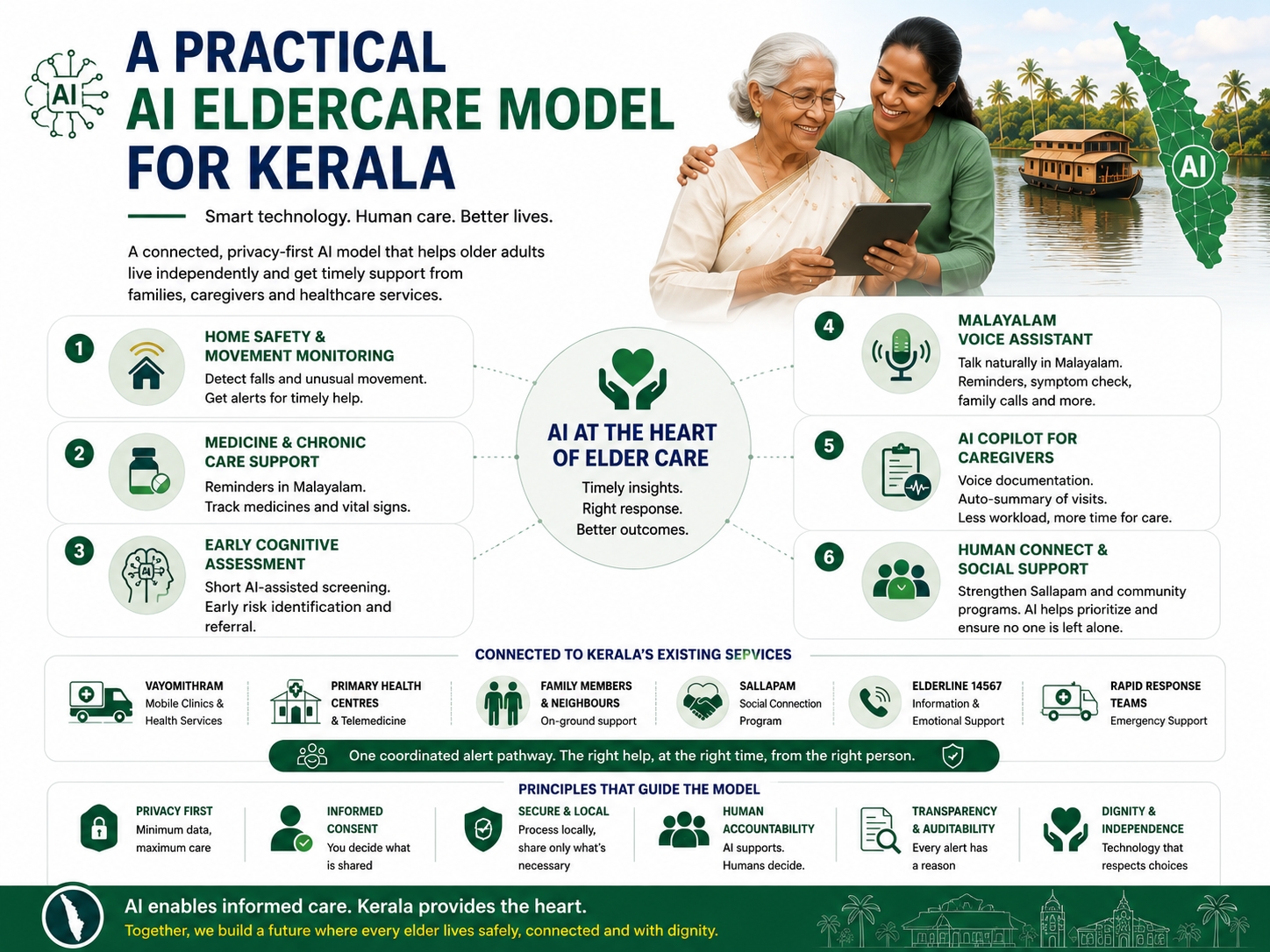
1. Privacy-first home safety monitoring
The first layer should focus on falls and unusual changes in daily activity.
Non-camera sensors could monitor indicators such as:
- Whether the person has left the bed
- Unusual inactivity
- Irregular night-time movement
- Possible falls
- Significant changes in walking or routine
AI should learn a basic pattern of normal activity and identify meaningful deviations. A single late wake-up may not require intervention. A combination of late waking, reduced movement and failure to respond could justify an alert.
The alert should first ask whether the older person needs help. It should then follow an agreed escalation process involving a family member, neighbour, healthcare worker or emergency service.
2. Medicine and chronic-care support
Many older adults manage diabetes, hypertension, cardiac conditions and multiple prescriptions. A basic reminder is useful, but AI can provide more context.
With informed consent, a system could combine information from a digital medicine box, glucometer, wearable device or symptom report. It could recognise repeated missed medicines or unusual readings and prepare a summary for a qualified healthcare professional.
Kerala already has programmes such as Vayomithram and Vayomadhuram that support elderly healthcare and diabetes management. AI-supported monitoring could strengthen these services rather than operate separately from them.
The technology must never independently alter a dose or present a medical diagnosis. Its role should be reminder, documentation, risk prioritisation and connection to professional care.
3. Earlier cognitive assessment
Kerala could evaluate short, clinician-supervised digital screening tools for identifying possible cognitive decline.
The most suitable initial settings would be primary health centres, mobile clinics and geriatric camps—not unsupervised consumer applications claiming to diagnose dementia.
When a screening result suggests possible risk, the person should be referred to a qualified professional. AI should support early identification, not attach a permanent label to an older adult.
4. Malayalam voice assistance
Many eldercare applications are designed around English text and complex menus. That will limit their usefulness in Kerala.
A practical eldercare assistant should support natural Malayalam speech. It could:
- Provide medicine and appointment reminders
- Read health instructions aloud
- Allow the person to report symptoms
- Initiate a family or nurse call
- Explain why an alert was generated
- Repeat information slowly when requested
Voice interaction must be designed for different accents, hearing difficulties and speech impairments. Important instructions should be verified rather than assumed to have been understood.
5. AI copilots for caregivers and nurses
AI can also help the workforce caring for older people.
A care worker could dictate notes in Malayalam, after which a system converts them into a structured record. AI could summarise changes since the previous visit, identify missing documentation and prepare relevant information for clinical review.
Japan’s current research into voice-AI documentation and AI-supported care plans is particularly relevant here.
However, a care plan produced by AI must remain a draft. The responsible nurse, doctor or care professional should review and approve it.
6. Human support for loneliness
Social isolation should not be treated as a problem that a chatbot can solve alone.
Kerala’s Sallapam scheme already connects isolated senior citizens with younger telephone companions. AI could support the programme by scheduling calls, identifying missed contacts, translating or transcribing notes and helping coordinators prioritise elders who may require additional attention.
The conversation itself should remain human wherever possible.
A digital companion may provide reminders, music, stories or basic conversation. It should not become a justification for reducing family calls, volunteer interaction or community participation.
How should Kerala implement this?
Phase 1: Establish evidence through controlled pilots
The first phase should focus on a limited group of high-risk elders in two or three districts. Participants could include older adults who live alone, have a history of falls, manage multiple medicines or have early cognitive concerns.
The pilot should combine only a small number of functions:
- Privacy-friendly movement monitoring
- Malayalam voice assistance
- Medicine reminders
- A family and care-worker alert system
- Teleconsultation support
The programme should measure fall incidents, response time, medicine adherence, false alarms, caregiver workload, hospital admissions, user satisfaction and whether participants feel safer or more closely monitored.
Phase 2: Connect existing government services
Once the pilot demonstrates value, the platform could be connected to Vayomithram, primary health centres, Elderline, Sallapam and Rapid Response Teams.
The objective should be one coordinated escalation pathway—not several applications sending uncoordinated notifications.
A standard alert might move through four levels:
- Ask the older person whether help is required.
- Notify a registered family member or neighbour.
- Contact a designated health or social-care worker.
- Escalate to emergency or district-response services when serious risk is detected.
Every alert should include the reason it was generated and the minimum information needed to respond.
Phase 3: Scale proven solutions and evaluate advanced technologies
Only after the basic care network is functioning should Kerala consider more advanced applications such as:
- Predictive frailty assessment
- AI-supported rehabilitation
- Digital twins for care planning
- Advanced dementia-support systems
- Robotic assistance for physically demanding care work
Humanoid care robots should initially be restricted to research institutions, rehabilitation settings and controlled clinical environments.
What safeguards does Kerala need?
An eldercare AI system will succeed only if older adults and their families trust it. Kerala should establish the following requirements before large-scale deployment:
The objective is independent ageing, not automated ageing
Kerala’s ageing challenge cannot be solved simply by importing Japanese robots or Swedish software.
The state must design a model around its own strengths: primary healthcare, local self-government, palliative-care networks, community participation, family connections and a highly capable technology ecosystem.
Japan shows that eldercare technology must cover the full care journey—from monitoring and nutrition to dementia support and future robotics.
Sweden shows that AI must be embedded in public-service workflows, supported by trained professionals and governed responsibly.
AI cannot replace the presence of a family member, the judgment of a doctor or the reassurance of a familiar caregiver.
It can, however, reduce the chance that an older adult’s silence is mistaken for safety.
Frequently Asked Questions
How can AI help elderly people living alone in Kerala?
AI can identify unusual movement, possible falls, missed medicines or changes in daily routines. It can then alert a family member, neighbour, healthcare worker or emergency service according to a predefined response plan.
Can AI prevent falls among older adults?
AI cannot prevent every fall. Movement-monitoring systems can identify behaviour associated with increased fall risk and alert caregivers earlier, allowing intervention before some incidents occur. Sweden’s Västra Götaland Region is implementing this approach in hospital care.
Can AI detect dementia?
AI can assist with cognitive screening and identify patterns that may require professional assessment. It cannot independently provide a definitive dementia diagnosis. Japan’s eye-tracking assessment demonstrates how AI can make initial cognitive evaluation faster and more accessible.
Will AI replace eldercare workers?
AI is more likely to support care workers by reducing documentation, organising health information and identifying people who may require attention. Physical care, emotional support and critical decisions will continue to require trained humans.
What should Kerala implement first?
Kerala should first test privacy-friendly fall-risk monitoring, Malayalam voice assistance, medicine support and connected human-response systems. Expensive humanoid robots should remain a longer-term research opportunity.
References and Links
- Kerala Vision 2031 – Empowering the Elderly
- Government of Kerala – Kerala State Policy for Senior Citizens 2026
- Kerala Social Justice Department – Senior Citizen Schemes
- Kerala Social Justice Department – Vayomithram
- Kerala Social Justice Department – Sallapam
- Kerala Social Justice Department – Elderline 14567
- Japan METI – Revised Priority Fields for Long-Term-Care Technology
- Japan Ministry of Health, Labour and Welfare – Promotion of Care Technology
- Japan Science and Technology Agency – AI Eye-Tracking Cognitive Assessment
- Japan Agency for Medical Research and Development – Current Healthcare and Care-Technology Projects
- Waseda University – AIREC and AI-Driven Caregiving Robotics
- Västra Götaland Region – AI-Supported Movement Monitoring
- AI Sweden – Mapping of AI Initiatives in Swedish Healthcare
- AI Sweden – Handbook for Information-Driven Healthcare and AI
- Government of Sweden – Sweden’s AI Strategy 2026