

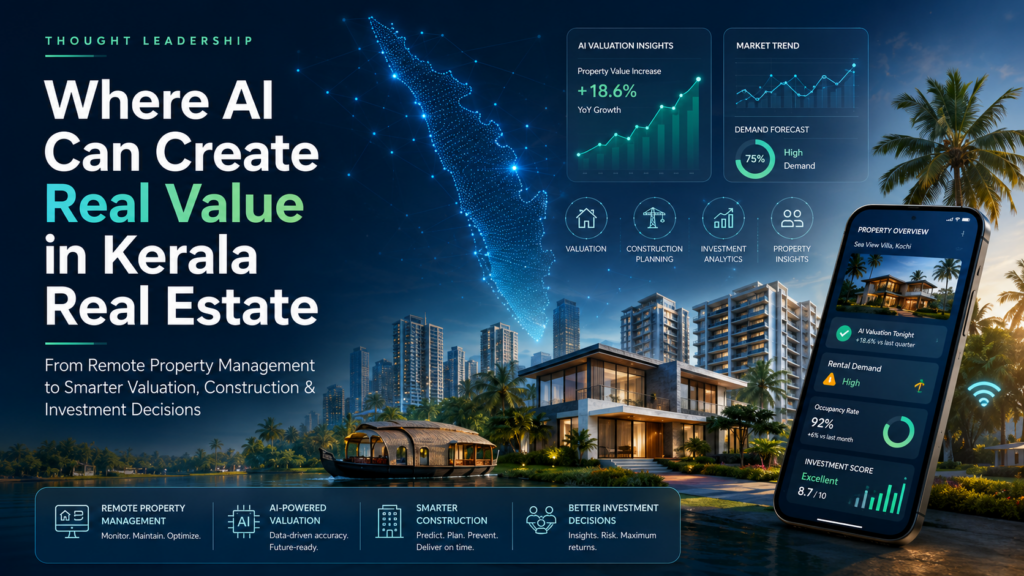
From Remote Property Management to Smarter Valuation, Construction and Investment Decisions
Imagine a professional from Kottayam who has been living in Canada for the past eight years. He owns his family house in Kottayam, an apartment in Kochi and a small commercial property in Ernakulam. Until recently, managing these properties depended almost entirely on relatives, phone calls, WhatsApp messages and occasional visits to Kerala.
Now imagine that a digital property-management platform monitors water consumption in the vacant house, identifies unusual electricity usage, reminds tenants about rent, stores maintenance invoices, tracks the apartment association’s notices and alerts the owner when an insurance policy or property-tax payment is due. When abnormal water flow is detected, the system checks the available information, identifies the possibility of a leak, recommends verified local technicians and asks the owner to approve the repair.
This is where artificial intelligence can create real value in Kerala real estate.
The value does not come from replacing the property owner, broker, engineer or lawyer. It comes from reducing the distance between the property and the people responsible for it. It reduces delay, uncertainty, repetitive work and dependence on informal communication.
Globally, AI could unlock between $430 billion and $550 billion in value across the real estate ecosystem. However, the largest gains are expected not from isolated chatbots or content-generation tools, but from redesigning complete workflows such as leasing, property operations, maintenance, investment analysis and financial reporting (McKinsey, 2026).
For Kerala, this transformation has particular significance.
Why Kerala Is Uniquely Positioned for AI-Enabled Real Estate
Kerala has one of India’s largest and most geographically distributed diaspora communities. The Kerala Migration Survey 2023 estimated approximately 2.2 million emigrants from the state, while remittances to Kerala reached ₹2,16,893 crore in 2023. This means that a substantial amount of Kerala’s property ownership, investment capital and household wealth is connected to people living outside the state or outside India.
Many such owners continue to depend on family members, brokers, caretakers or local representatives to supervise their properties. Information is often distributed across physical files, mobile phones, emails, bank statements, association messages and government portals.
At the same time, Kerala is gradually developing the digital infrastructure needed for more intelligent property services. K-RERA provides online access to registered projects, project status, promoter information, complaints and regulatory records. The Registration Department offers digital access to services such as encumbrance-certificate applications and certified copies. The Ente Bhoomi programme is creating digitally surveyed land records using technologies such as GPS, CORS networks, electronic total stations and computer-generated sketches.
AI can become the layer that helps owners, developers and professionals interpret and act on this growing volume of information.
1. Remote Property Management for NRIs
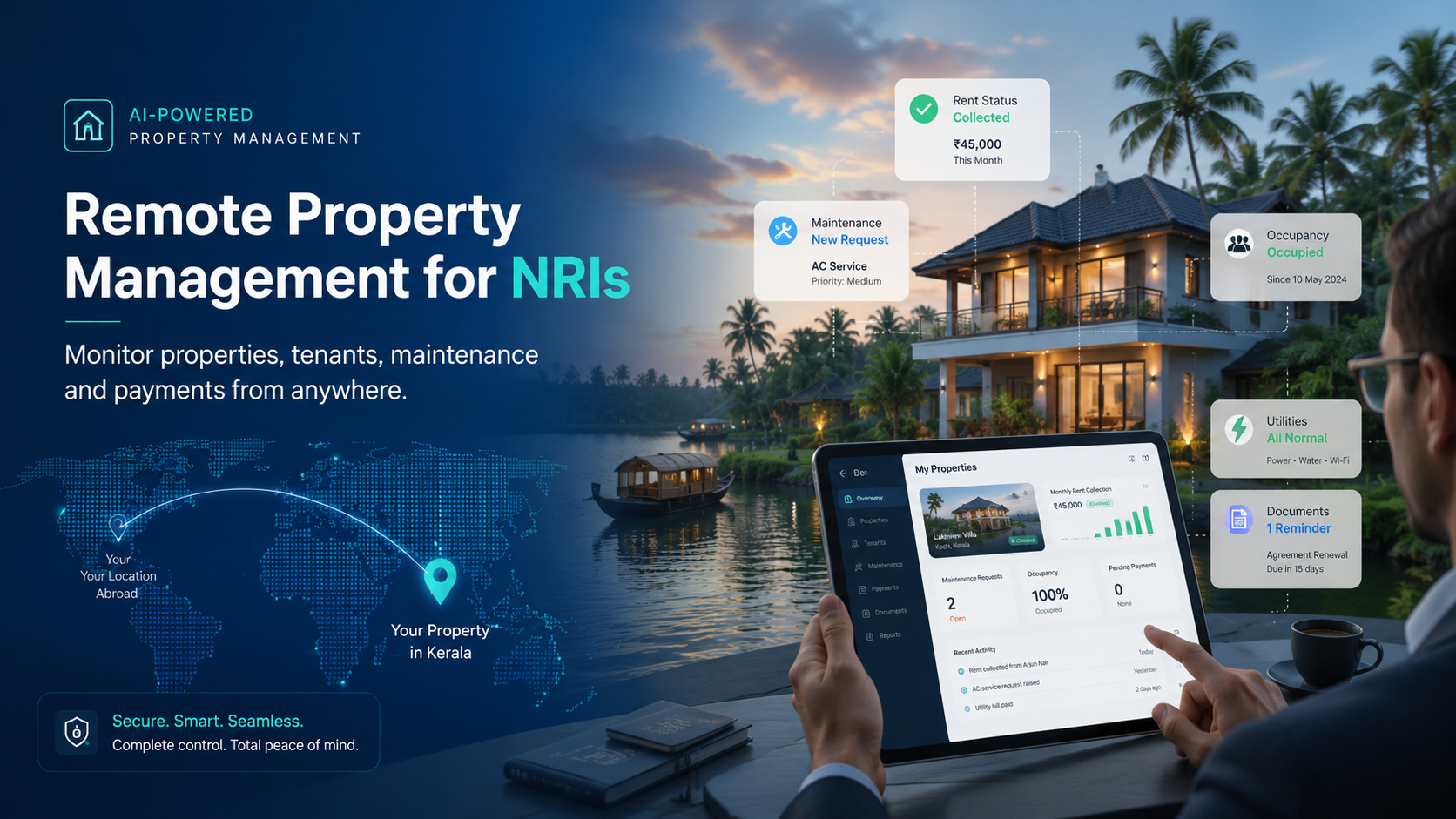
One of the most valuable applications of AI in Kerala will be the remote management of residential and commercial properties.
Today, an NRI property owner may have to contact different people for rent collection, repairs, tax payments, association fees, utility bills, legal documentation and tenant communication. The owner often receives information only when a problem becomes serious.
An AI-enabled property-management system could bring these activities into one workflow.
It could:
- Maintain a digital record of leases, invoices, warranties, tax receipts and service history.
- Monitor rent payments and automatically send reminders.
- Categorise tenant complaints according to urgency.
- Compare repair quotations and highlight unusual costs.
- Schedule inspections and preventive maintenance.
- Detect abnormal water or electricity consumption.
- Remind owners about insurance, property tax, association fees and lease renewals.
- Generate monthly property-performance summaries.
- Escalate urgent issues to a human property manager.
The system could also communicate in English and Malayalam, allowing tenants, caretakers, technicians and owners to interact more naturally.
The objective is not to automate every decision. Expensive repairs, tenant disputes, legal notices and emergency situations should continue to involve responsible human professionals. AI should organise information, identify exceptions and make the owner’s decisions faster and better informed.
For Kerala’s globally distributed property owners, this could transform property management from an informal, reactive activity into a documented and accountable service.
2. AI-Enabled Property Care and the Growth of Professional Management Services
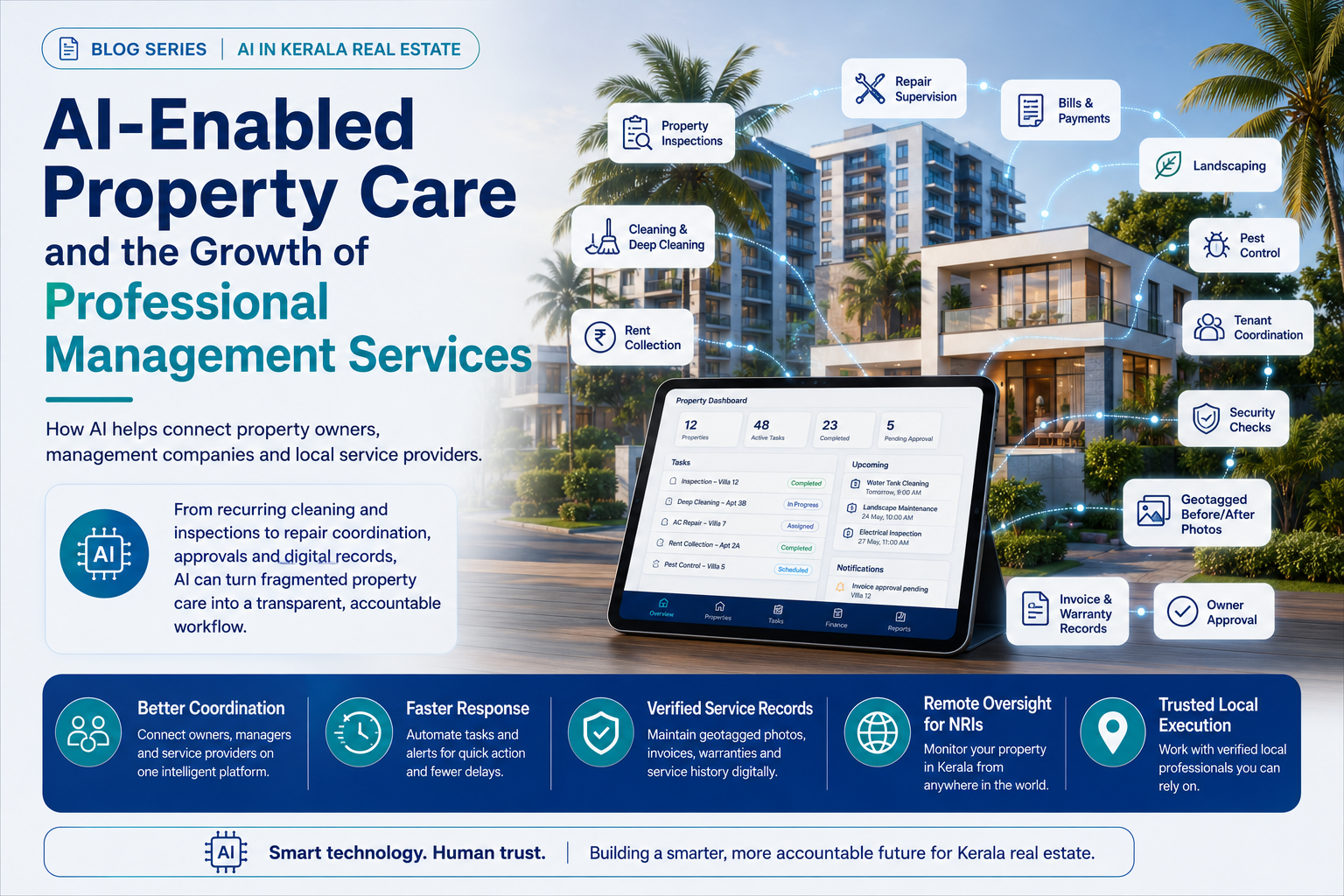
Professional property care is already developing as a separate service industry in Kerala. A growing number of companies now provide services specifically for NRIs, investors and owners who live outside the state. These services include periodic property inspections, regular and deep cleaning, landscaping, pest control, tenant coordination, rent collection, repair supervision, security checks, bill payments and maintenance of vacant houses.
Companies Already Providing Property-Management Services in Kerala
Several companies are currently operating or promoting professional property-care and NRI property-management services across different parts of Kerala.
Rental Cochin offers property monitoring, rental management and vacant-property management services for NRIs. Its publicly listed services include property inspections, housekeeping and cleaning, tenant screening, rent collection, bill payments, repair coordination, documentation assistance and photographic updates for owners living outside Kerala. The company also displays a K-RERA agent registration on its website.
Izber Property Management Services, based in Kochi, provides NRI property management, professional cleaning, housekeeping, facility management, building maintenance, security services, tenant management and rent collection. It also advertises support for property inspection, repairs, documentation, financial reporting and rental or sale marketing.
Nesture Property Care advertises property-management services in Kochi and Thiruvananthapuram, along with Bengaluru. Its services include tenant coordination, rent follow-up, routine inspections, maintenance management and regular updates for property owners based in countries such as the UAE, United States, Canada and United Kingdom.
CLEAR Property Management, based in Changanassery, serves NRI-owned properties in and around Central Travancore. Its publicly listed services include property maintenance, tenant management, construction coordination, periodic cleaning, utility and tax payments and vehicle maintenance.
Travancore Holdings, headquartered in Thiruvananthapuram, positions itself as a real estate and property-management company serving NRIs, investors, landlords and corporate clients. It states that its services combine local property expertise with technology-enabled and transparent management systems.
Other examples include
Heavenix, which advertises regular cleaning, deep cleaning, general maintenance, garden maintenance, property monitoring, security checks and vehicle care, and
Magnet Properties, which promotes maintenance, cleaning, security, CCTV monitoring and complete building solutions for non-resident Keralites.
These companies demonstrate that the property-care opportunity in Kerala is not merely theoretical. A local network of property managers, cleaners, electricians, plumbers, gardeners, security providers, contractors and maintenance professionals already exists.
However, much of the coordination still happens through individual phone calls, WhatsApp messages, spreadsheets, photographs and separate service providers. The property owner may not have one reliable system showing when an inspection was completed, what problem was found, which quotation was approved, how much was paid and whether the work was completed properly.
AI can become the coordination layer connecting property owners, professional property-management companies and local service providers.
The Next Opportunity: Using AI to Strengthen Existing Property-Care CompaniesThe presence of these companies demonstrates that Kerala already has the essential human and service infrastructure required for professional property management. However, based on their publicly available information, it should not be assumed that all these companies currently operate through AI-enabled systems.
Most of them appear to depend primarily on property managers, technicians, cleaners, contractors, phone calls, WhatsApp communication, spreadsheets, photographs and manual follow-up. Some companies have introduced online platforms, dashboards or technology-supported services, but this is different from using AI across the complete property-management workflow.
This gap represents the real opportunity.
AI does not need to create an entirely new property-care industry in Kerala. Instead, it can help existing companies improve the speed, transparency, consistency and scale of the services they already provide.
An AI platform could work as an intelligent coordination layer between:
- Property owners and NRIs.
- Property-management companies.
- Tenants and apartment associations.
- Cleaners, plumbers and electricians.
- Gardeners and pest-control providers.
- Security personnel and caretakers.
- Civil contractors and repair teams.
- Legal, valuation and documentation professionals.
For example, a property-management company may currently receive a message from an NRI owner, manually contact several technicians, collect quotations through WhatsApp, forward them to the owner and wait for approval. After the repair, photographs and invoices may be sent separately, making the full history difficult to track.
With AI support, the same company could receive the complaint through one system, classify its urgency, retrieve the property’s service history, prepare a standard work request, recommend suitable technicians, compare quotations and alert the owner when approval is required.
The system could then track the work until completion, request geotagged before-and-after photographs, organise the invoice and update the property’s maintenance record.
AI could help existing Kerala property-care companies in several areas:
- Automatically classify property complaints and service requests.
- Match each task with an appropriate local service provider.
- Prioritise urgent issues such as leakage, electrical faults or security problems.
- Compare quotations and identify unusual cost differences.
- Schedule inspections, cleaning and preventive maintenance.
- Generate Malayalam and English communications.
- Monitor delays and send automatic follow-up reminders.
- Analyse photographs to identify visible damage or incomplete work.
- Maintain digital records of repairs, payments and warranties.
- Generate monthly reports for NRI property owners.
- Predict maintenance requirements using previous service history.
- Identify frequently recurring problems in a property.
- Measure technician response time and service-provider performance.
- Forecast staffing and service demand across different locations.
- Help property managers supervise more properties without reducing service quality.
This means AI would not compete with existing Kerala property-management companies. It could become a tool that allows them to deliver a better service.
A small property-management company may currently be able to manage only a limited number of homes because every task requires manual coordination. With an AI-enabled workflow, the same team could manage a larger portfolio, respond faster, maintain more complete records and provide owners with greater transparency.
Local professionals would continue to perform the physical work. Cleaners would still clean the property, engineers would still inspect technical issues, plumbers and electricians would still complete repairs, and property managers would still handle sensitive decisions and owner relationships.
AI would support them by organising the work, identifying priorities, reducing repetitive communication and documenting every important action.
The opportunity for Kerala is therefore not simply the creation of new AI property-management companies. It is also the modernisation of existing property-care businesses through partnerships between AI technology providers, established management companies and trusted local service professionals.
Companies such as Rental Cochin, Izber, Nesture Property Care, CLEAR Property Management, Travancore Holdings, Heavenix and Magnet Properties already provide or promote many of the essential on-ground services. AI can help such businesses transform these individual services into a more connected, accountable and scalable property-management system.
The winning model may therefore combine three essential elements:
AI-powered coordination, professional property-management oversight and trusted local execution.Technology can provide intelligence, automation, records and transparency. Existing Kerala companies can provide local knowledge, customer relationships and operational management. Local professionals can provide the physical services and human accountability required to protect the property.
3. More Reliable Property Valuation
Property valuation in Kerala can be difficult because prices may vary significantly between nearby localities. A property’s value can be influenced by road access, plot shape, frontage, neighbourhood development, flood exposure, building age, construction quality, rental potential and proximity to schools, hospitals, employment centres and transport infrastructure.
AI-powered valuation systems can combine multiple categories of information, including:
- Registered property transactions.
- Asking prices and rental listings.
- Building age, area and condition.
- Location and accessibility.
- Comparable sales.
- Neighbourhood development.
- K-RERA project information.
- Flood and landslide exposure.
- Local rental demand.
- Property photographs and inspection reports.
Instead of presenting only one estimated price, a responsible AI valuation system should show a probable value range, the comparable properties used, important property characteristics and the level of confidence in the result.
This is especially useful when an NRI owner wants to know whether to sell, rent, renovate or retain a property. It can also help banks, developers, brokers and investors conduct an initial assessment before ordering a detailed professional valuation.
However, an algorithmic estimate must not be treated as a legal or professional valuation. Research shows that large language models can produce useful and understandable property-price estimates, but may struggle with spatial reasoning and may express excessive confidence in their conclusions. Traditional statistical and machine-learning models also remain stronger for some pure prediction tasks.
The strongest model for Kerala is therefore
AI-assisted valuation: technology analyses the data and identifies comparable properties, while a qualified professional validates the physical condition, legal context and local market factors.
4. Smarter Property Search and Buyer Matching
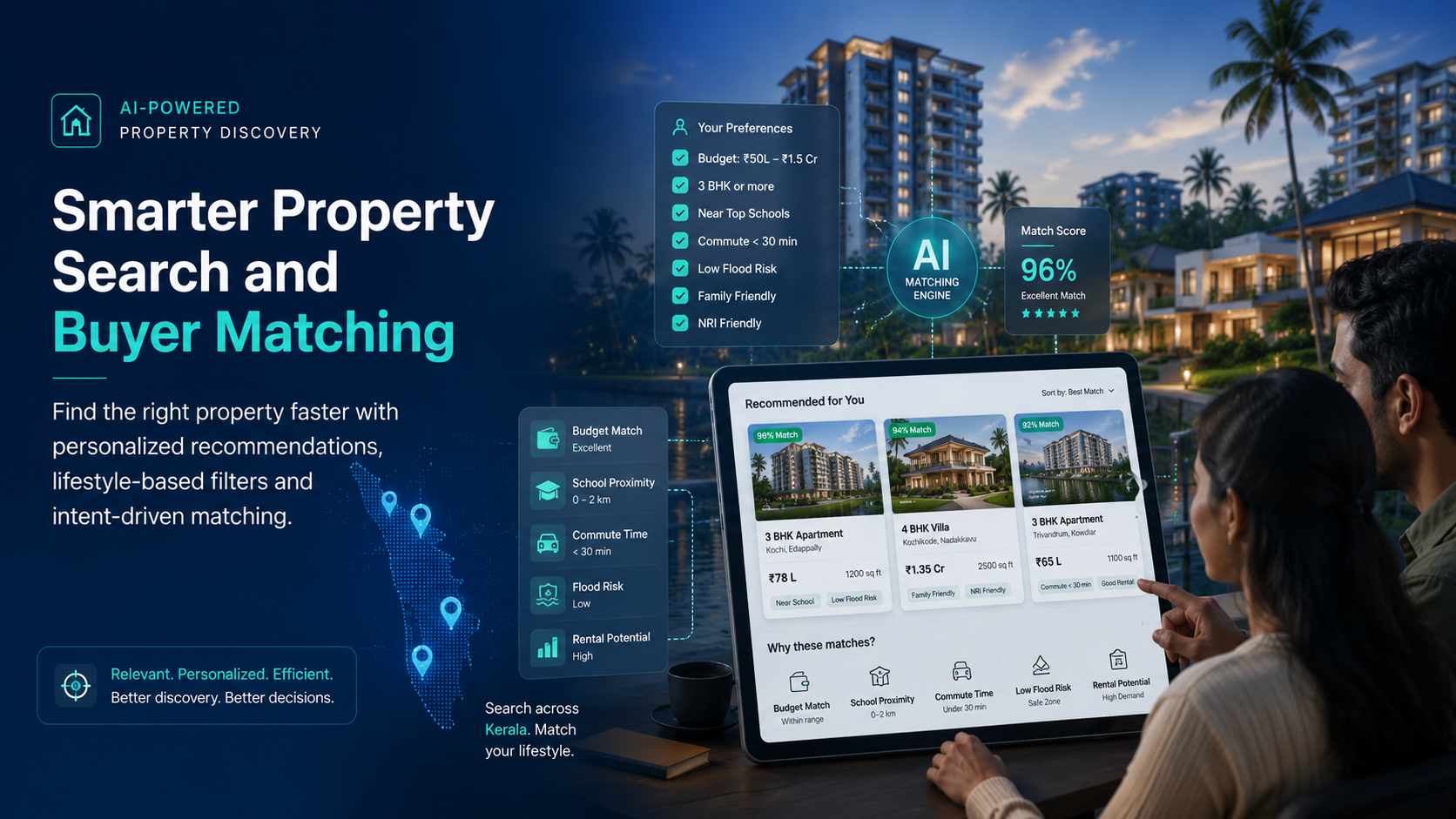
A typical property portal allows people to filter listings by price, location, property type and number of bedrooms. But real buying decisions are more complex.
A family may want a home that is:
- Close to a particular hospital.
- Accessible to elderly parents.
- Within a certain travel time from Infopark or Technopark.
- Near a school or college.
- Suitable for rental income.
- Less exposed to flooding.
- Easy to maintain from overseas.
- Capable of accommodating future extensions.
- Suitable for retirement after returning to Kerala.
AI can understand these combined requirements and recommend properties based on the buyer’s actual life situation rather than only basic filters.
For example, an NRI planning to return after five years may value future infrastructure, rental demand and healthcare access differently from a person purchasing a home for immediate occupation.
Recommendation systems are already being developed using combinations of recent user activity, long-term preferences, property characteristics and locality popularity. Such models can improve the relevance of property recommendations when they are built on reliable data and transparent criteria.
For developers and brokers, this means fewer irrelevant leads. For buyers, it means less time spent reviewing unsuitable properties.
5. Better Lead Qualification and Customer Engagement
Real estate enquiries rarely arrive only during office hours. This is particularly true when potential buyers live in the UAE, Europe, North America or Australia.
An AI-enabled sales system can respond throughout the day, collect the buyer’s requirements, answer basic project questions, share approved documents, schedule calls and identify serious purchase intent.
The real value, however, is not simply having a chatbot on a website.
AI should support the complete journey from enquiry to booking by:
- Capturing the source and context of the enquiry.
- Understanding the buyer’s budget, preferred location and timeline.
- Recommending relevant properties.
- Answering approved project questions.
- Scheduling virtual or physical visits.
- Reminding the sales team about follow-ups.
- Identifying unanswered objections.
- Recording interactions in the CRM.
- Alerting management when high-intent leads are being neglected.
AI adoption in Indian corporate real estate has grown rapidly, with 91% of surveyed organisations reportedly piloting or planning AI-enabled real estate solutions by 2025. Yet only 5% reported achieving most of their AI objectives, illustrating the difference between experimenting with tools and creating measurable business results (JLL, 2026).
Kerala developers should therefore measure AI using business outcomes such as response time, site-visit conversion, booking conversion, lead leakage and sales-cycle length—not simply the number of chatbot conversations.
6. Construction Monitoring and Project Transparency
Construction delays, cost escalation and inconsistent communication are common concerns for property buyers. For NRIs who cannot visit the site regularly, verifying construction progress can be particularly difficult.
Computer vision can analyse photographs, drone imagery and site-camera feeds to compare actual construction progress against schedules, drawings or Building Information Models.
AI can help project teams:
- Estimate the percentage of work completed.
- Identify visible defects or incomplete work.
- Compare progress across buildings or floors.
- Detect possible safety violations.
- Monitor material movement.
- Identify delays earlier.
- Generate weekly progress summaries.
- Organise photographs according to location and date.
- Provide authorised buyers with verified visual updates.
Instead of sending a few manually selected photographs to buyers, a developer could provide a structured progress dashboard showing completed milestones, upcoming work and approved schedule changes.
This can improve trust, particularly for NRI buyers investing in apartments or villas before completion. It can also help developers maintain evidence for contractors, consultants, lenders and regulators.
AI-generated progress estimates should nevertheless be reviewed by engineers. Computer vision can highlight probable issues, but it cannot replace structural inspections, statutory certifications or professional accountability.
7. Predictive Maintenance for Kerala’s Climate
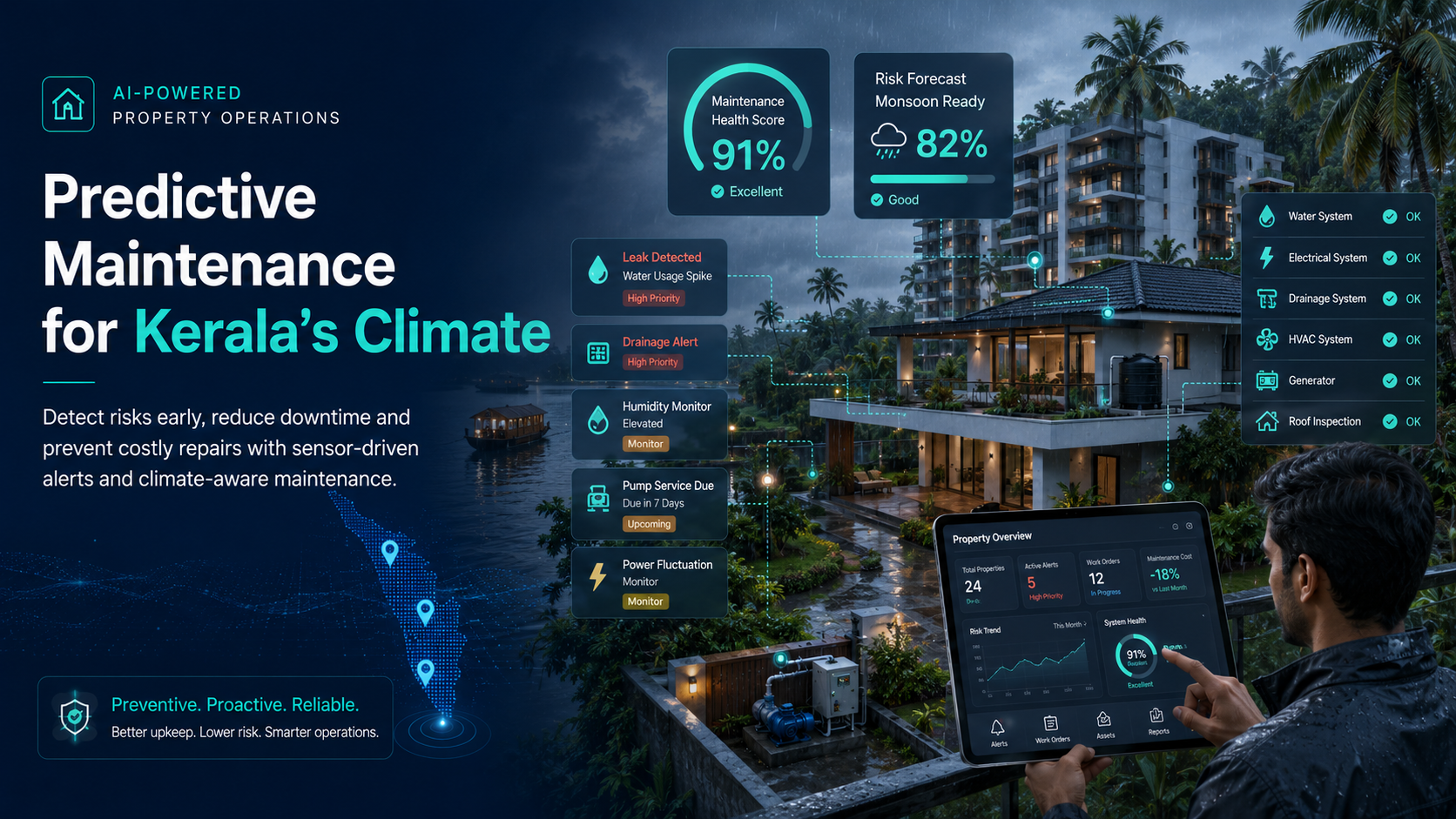
Kerala properties face environmental conditions that make preventive maintenance especially important. Heavy rainfall, high humidity, water penetration, corrosion, mould, blocked drainage and electrical problems can create significant repair costs when they are detected late.
The Kerala State Disaster Management Authority publishes district-level flood-hazard probability maps, landslide-susceptibility information and other hazard datasets. Kerala’s exposure to floods and landslides has also resulted in major economic and property losses, most visibly during the 2018 disaster.
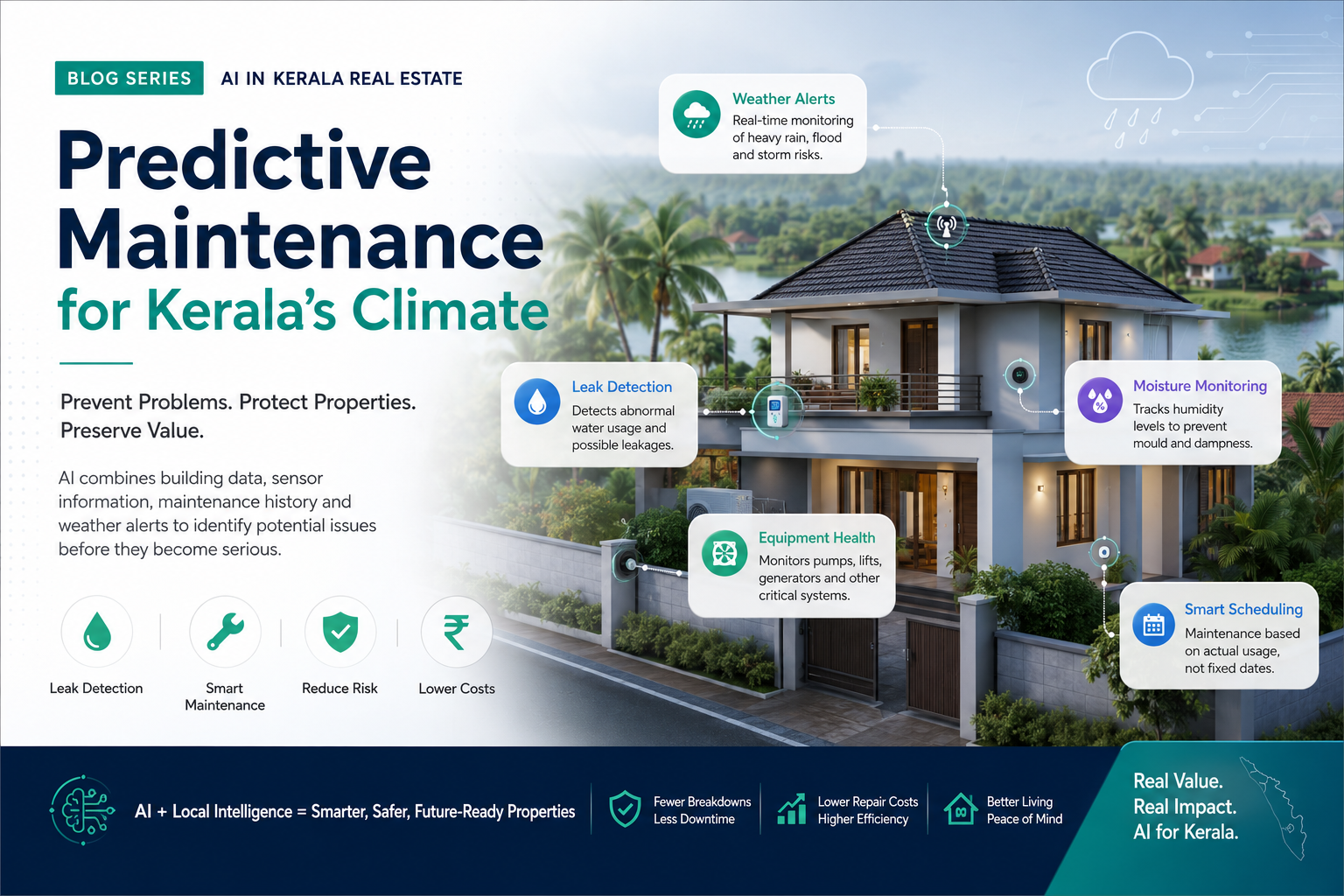
AI can combine building data, sensor information, maintenance history and weather alerts to identify potential problems before they become serious.
Examples include:
- Detecting abnormal water consumption that may indicate leakage.
- Monitoring moisture levels in vacant houses.
- Predicting pump, lift or generator servicing requirements.
- Identifying repeated electrical fluctuations.
- Prioritising roof and drainage inspections before the monsoon.
- Monitoring energy consumption in apartment buildings.
- Flagging properties requiring flood-preparedness measures.
- Scheduling maintenance based on usage rather than fixed dates.
For large apartment communities, hospitals, resorts, malls and commercial buildings, even modest improvements in maintenance planning can reduce downtime and prevent expensive emergency repairs.
For individual NRI-owned houses, the value is peace of mind: the owner receives an early warning rather than learning about extensive damage several months later.
8. Faster Document Review and Due Diligence
Property transactions in Kerala may involve title deeds, previous deeds, encumbrance certificates, land-tax receipts, possession certificates, building permits, approved plans, completion certificates, occupancy certificates, RERA records, association documents and identity records.
Reviewing these documents is time-consuming, particularly when they contain differences in spelling, survey numbers, boundaries, ownership names or property descriptions.
AI document-processing systems can:
- Convert scanned documents into searchable text.
- Extract names, dates, survey numbers and property measurements.
- Compare information across multiple documents.
- Identify missing documents.
- Highlight inconsistent names or boundaries.
- Summarise long agreements.
- Create due-diligence checklists.
- Translate selected information between Malayalam and English.
- Organise documents into a secure transaction record.
Kerala’s expanding digital land-record, registration and K-RERA systems provide an increasingly useful foundation for this type of document intelligence.
However, AI must never be presented as providing a legal title guarantee. A system may identify possible inconsistencies, but a qualified advocate must verify ownership, encumbrances, legal rights, succession issues, restrictions and transaction validity.
In this area, AI creates value by helping legal professionals and buyers identify issues faster not by replacing legal due diligence.
9. Climate-Aware Investment Decisions
Traditional property investment analysis frequently focuses on purchase price, expected appreciation and rental income. In Kerala, long-term analysis should also consider environmental and operational risk.
AI can combine property, location and hazard information to help investors examine:
- Historical and projected rental demand.
- Maintenance and insurance expenses.
- Flood or landslide exposure.
- Water availability.
- Road accessibility.
- Coastal or river proximity.
- Building age and resilience.
- Local infrastructure proposals.
- Vacancy risk.
- Potential renovation costs.
- Alternative uses for the property.
For example, two properties may offer similar rental income, but one may require higher annual maintenance because of water penetration, coastal corrosion or repeated drainage problems. AI-supported analysis can make these hidden costs more visible.
This can help buyers move from a simple “price per square foot” comparison to a more complete understanding of the property’s probable lifetime cost and risk.
10. AI-Assisted Investment Around Vizhinjam and Other Growth Corridors
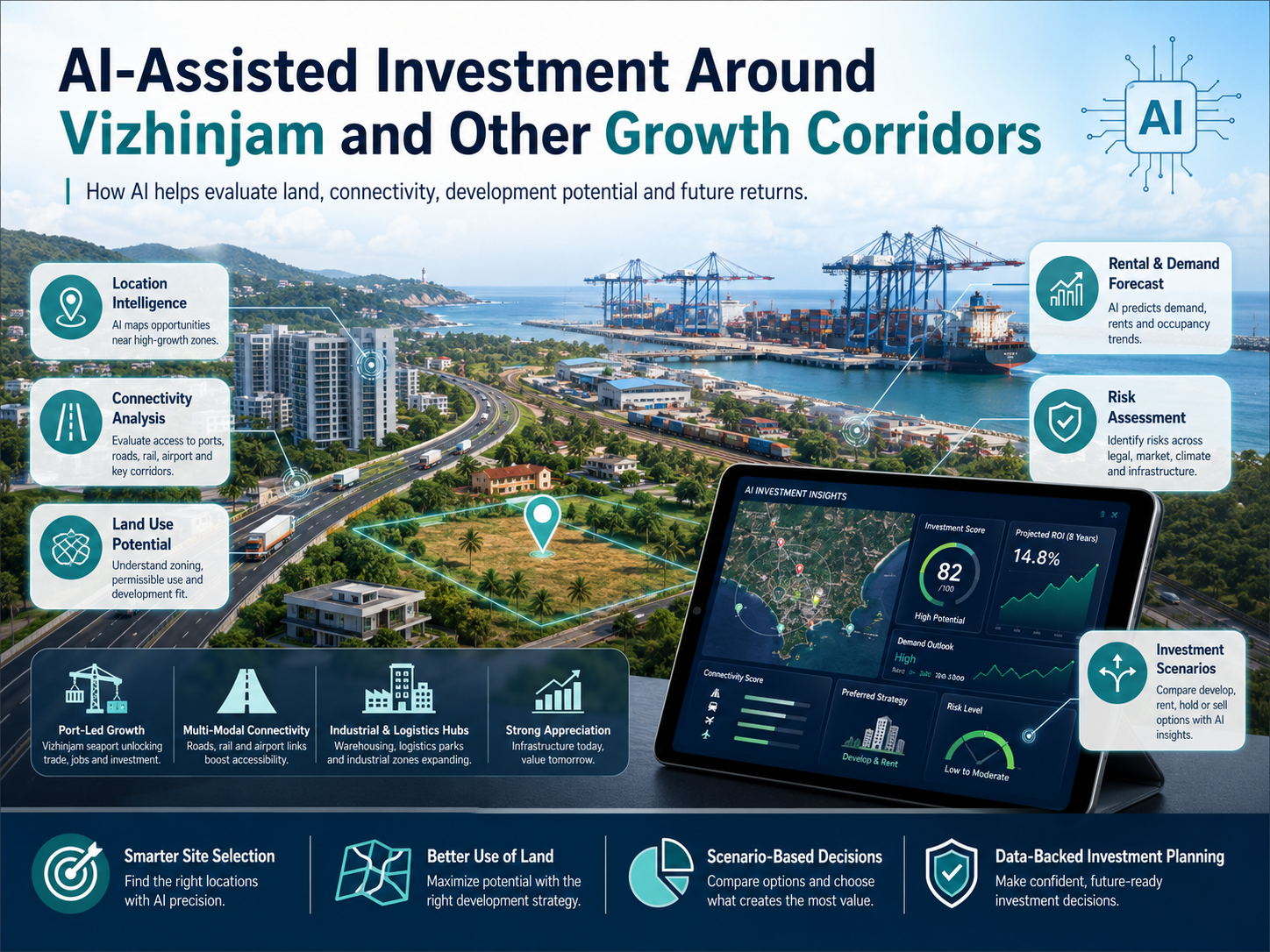
Vizhinjam provides an important example of how AI could support infrastructure-led property and land-investment decisions in Kerala.
The value of a major seaport is not limited to ships and container handling. A successful port can create demand for logistics facilities, warehouses, cold-storage infrastructure, transportation services, offices, accommodation, retail, hospitality, repair services and workforce-support facilities.
Vizhinjam International Seaport Limited’s current business plan proposes port-led industrialisation across approximately 3,500 acres in multiple phases. It has identified facilities such as multimodal logistics parks, inland container depots, free-trade warehousing zones, container-freight stations, specialised cold chains and truck terminals. The plan targets substantial investment and employment creation over the next five to eight years. These are official development targets rather than guaranteed outcomes, but they indicate the types of economic activity that may emerge around the port.
AI can help investors examine how such development could affect different locations, rather than simply assuming that every property near the port will increase in value.
An AI-supported location-intelligence system could combine:
- Distance and travel time to the port.
- Access to NH 66, proposed road connections, rail connectivity and the airport.
- Current and proposed land use.
- Permitted construction and zoning restrictions.
- Plot size, shape, road frontage and road width.
- Recent sale and rental transactions.
- Commercial and residential rental demand.
- Planned logistics and industrial facilities.
- Flood, drainage, coastal and environmental risks.
- Availability of power, water and other infrastructure.
- Construction and land-development costs.
- Vacancy, operating and maintenance expenses.
- Expected employment and population movement.
- Comparable developments around other ports and industrial corridors.
The system could then produce several possible scenarios instead of giving only a general prediction that land prices may rise.
How Can an Owner Benefit from an Existing House?
For a house located within a practical commuting distance of the port, AI could compare options such as:
- Continuing to use it as a normal residence.
- Renting it to families working in the surrounding economic area.
- Renovating it for managed employee accommodation.
- Operating it as a permitted serviced stay or guest accommodation.
- Converting part of it into an office or professional space where legally allowed.
- Retaining it while monitoring future development.
- Selling it and reinvesting in a location with stronger expected demand.
For every option, the system could estimate renovation cost, likely rent, expected occupancy, regulatory requirements, operating expenses and a probable break-even period.
How Can an Owner Benefit from Vacant Land?
For an undeveloped plot, AI could assess the lawful and financially viable uses permitted for that location.
Depending on zoning, road access, plot size and surrounding demand, the options might include:
- Residential development.
- Rental housing.
- Worker or staff accommodation.
- Small warehouses or storage facilities.
- Cold-chain or food-related facilities.
- Commercial or mixed-use development.
- Truck or vehicle-support services.
- Subdivision and sale.
- Continued agricultural use.
- Retaining the land until infrastructure and demand become clearer.
The platform could compare the expected cost, approval timeline, income potential, market risk and environmental constraints of each option. This type of analysis is often called a
highest-and-best-use assessment: identifying the most appropriate legally permitted and financially feasible use of a property.
AI should not simply say, “Buy this property because Vizhinjam will increase its price.” A responsible system should present different development scenarios, show the supporting data, identify uncertainties and explain why one location may benefit more than another.
A property with suitable road frontage near a planned logistics facility may have different potential from an inland residential plot, even when both are geographically close to Vizhinjam. Similarly, land exposed to flooding, access restrictions, coastal regulation or expensive infrastructure requirements may carry greater risk despite its proximity to the port.
Examples from Other Countries
Singapore demonstrates how port development, industrial planning and land-use decisions can be considered together. Its plans for Tuas Port include clustering complementary industries such as logistics, e-commerce, advanced manufacturing and cold-chain operations. Singapore’s planning authorities also use data analytics, geospatial platforms, 3D simulations and AI to test development scenarios and understand how infrastructure and land should be used.
This does not mean that Singapore’s land is expensive only because of its port. Singapore has limited land, strong international business activity, extensive infrastructure and long-term government planning. The relevant lesson for Kerala is that a port creates greater property value when it is connected to industries, roads, logistics systems, employment centres and carefully planned land use.
Australia provides a more direct property-investment example. Platforms such as Archistar use AI, planning information, zoning rules, market data and generative design to identify development sites, assess feasibility and produce potential building concepts. Its due-diligence reports are designed to answer the question, “How can I best use this piece of land?”
A similar Kerala-focused system could combine Ente Bhoomi information, registration data, local building rules, infrastructure plans, hazard information, market transactions and rental demand. It could help owners understand not only
what their property is currently worth, but also
what the property could realistically become.
11. Better Decisions About Vacant and Underused Properties
Kerala contains many houses and apartments that are occupied only occasionally because their owners live elsewhere.
AI can help owners decide whether a property should be:
- Rented on a long-term basis.
- Used for short-term stays where legally and operationally suitable.
- Renovated for senior living.
- Converted into managed accommodation.
- Sold and reinvested elsewhere.
- Retained for the owner’s eventual return.
- Professionally maintained while remaining vacant.
The system can estimate likely rent, vacancy, operating expenses, renovation cost and maintenance requirements under different scenarios.
This is not about allowing an algorithm to make the final decision. Property decisions often involve family history, retirement plans, inheritance and emotional attachment. AI can calculate scenarios, but the owner must decide what the property means to the family.
12. More Efficient Developer Operations
For developers, some of the earliest measurable returns may come from internal operations rather than futuristic smart buildings.
AI can support:
- Market and micro-market research.
- Land-opportunity screening.
- Project feasibility analysis.
- Demand forecasting.
- Unit-mix planning.
- Inventory and pricing review.
- Marketing-content adaptation.
- Lead scoring.
- Payment and collection reminders.
- Customer-service ticket management.
- Contract and invoice review.
- Project reporting.
- Management dashboards.
Industry research shows that organisations further along in AI adoption are prioritising financial planning, risk management and property operations. At the same time, only a small proportion of surveyed real estate companies report having well-structured data and robust privacy processes, demonstrating that data readiness remains a major constraint (Deloitte, 2025).
A Kerala developer with information spread across spreadsheets, WhatsApp, accounting software, CRM tools and physical documents should not begin by purchasing several unrelated AI products. The first priority should be to organise the underlying data and redesign one important workflow from beginning to end.
Where AI Will Not Create Sustainable Value
Not every use of AI will improve real estate.
AI is unlikely to create lasting value when it is used only to:
- Generate large volumes of generic property advertisements.
- Automatically publish unverified market claims.
- Produce unrealistic property images.
- Assign opaque prices without explaining the data.
- Replace professional legal or engineering review.
- Collect excessive personal data.
- Automate sensitive tenant disputes without human involvement.
- Create fake reviews or testimonials.
- Add another disconnected tool to an already fragmented process.
Housing-related AI systems continue to show weaknesses in reasoning, hallucination control and the interpretation of complex transaction scenarios. This makes human verification essential, particularly when decisions involve ownership, lending, valuation or legal rights.
AI should reduce uncertainty, not introduce a new and less visible form of uncertainty.
A Practical AI Roadmap for Kerala Real Estate Companies
1. Select One High-Value Workflow
Begin with a clearly defined problem such as NRI property management, maintenance-ticket resolution, lead follow-up, document review or construction reporting.
Avoid launching many disconnected AI experiments at the same time.
2. Map the Complete Process
Document what happens from the beginning to the end of the workflow.
For a maintenance request, this would include complaint registration, classification, technician assignment, owner approval, repair completion, invoice verification and closure—not merely generating an automated reply.
3. Organise the Data
Clean and connect property records, customer information, service history, documents, transactions and communications.
AI built on incomplete or incorrect data will produce unreliable recommendations.
4. Retain Human Approval
Define which actions AI can perform automatically and which require approval from an owner, broker, engineer, lawyer, property manager or senior executive.
5. Protect Personal and Property Data
Real estate systems may process identity documents, financial information, contact details, ownership records and behavioural data. Companies must implement appropriate consent, access control, security, retention and grievance-handling practices aligned with India’s data-protection framework, including the Digital Personal Data Protection Rules, 2025.
6. Localise the System
Solutions should understand Malayalam and English, local address patterns, Kerala property terminology, survey-number formats, monsoon-related maintenance and district-level market differences.
7. Measure Business Outcomes
Useful performance indicators include:
- Reduction in maintenance-response time.
- Reduction in vacant days.
- Increase in rent collected on time.
- Reduction in lead-response time.
- Increase in site-visit conversion.
- Reduction in document-review time.
- Reduction in project-reporting effort.
- Reduction in avoidable repair costs.
- Improvement in customer satisfaction.
- Improvement in forecast accuracy.
Technology usage is not the final outcome. The outcome is whether the property is managed better, sold faster, maintained more efficiently or evaluated with greater confidence.
Conclusion: Kerala’s AI Opportunity Is Practical, Local and Investment-Aware
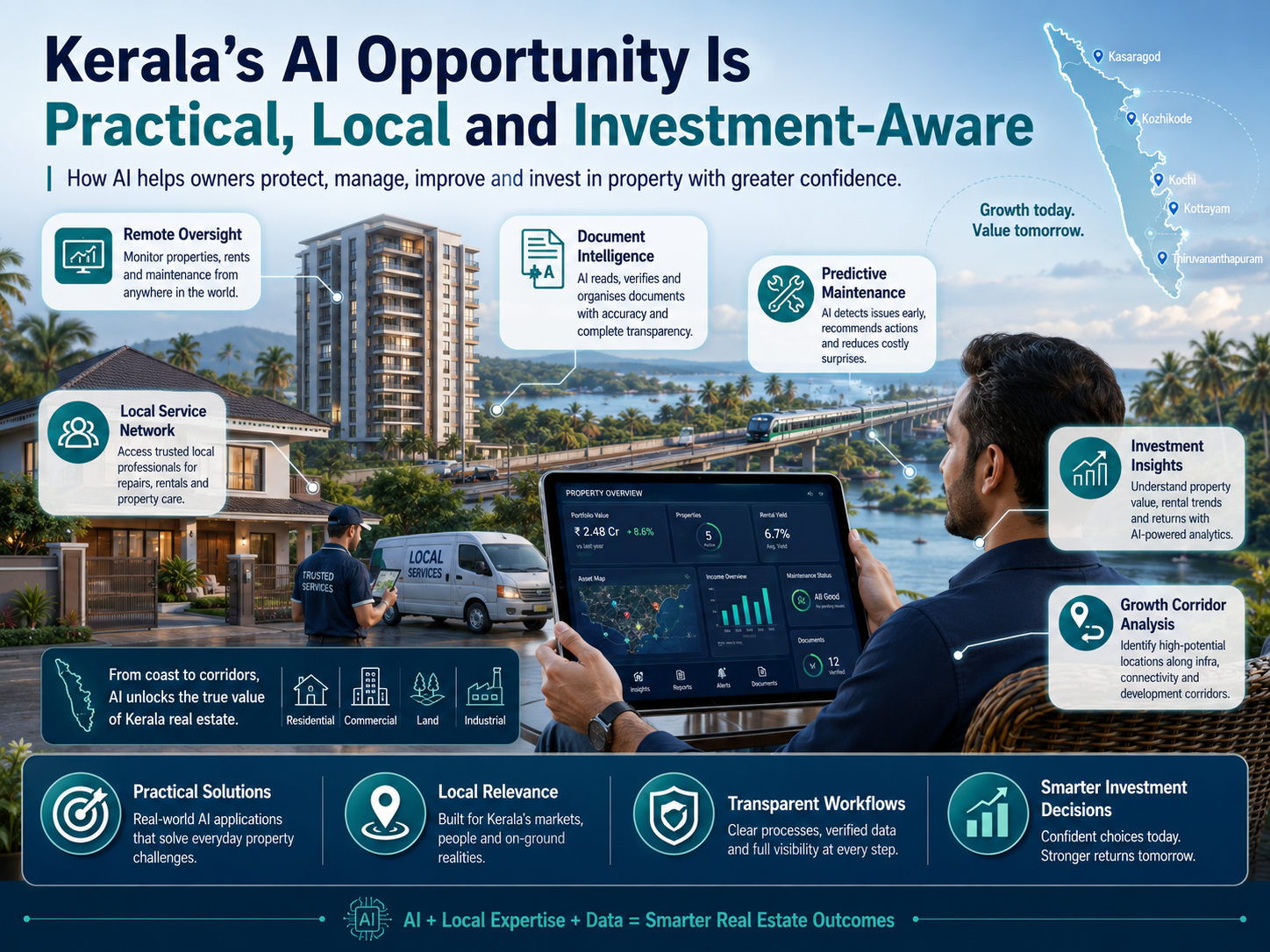
AI’s greatest contribution to Kerala real estate may not be a fully automated building or a robot property broker.
It may be something far more practical: allowing a property owner in Dubai, London, Toronto or Sydney to understand exactly what is happening to a house, apartment, commercial building or piece of land in Kerala.
It may connect that owner with a professional local network for cleaning, inspections, tenant management, repairs, landscaping, security and legal coordination. Instead of depending on disconnected phone calls and informal updates, the owner could receive documented information, quotations, approvals and completion reports through one transparent system.
AI may also help owners and investors understand the future potential of a property. Around Vizhinjam and other infrastructure-led growth corridors, it could analyse connectivity, permitted land use, employment demand, market activity, environmental risks and development costs. It could help answer practical questions such as: Should this house be rented, renovated, converted or sold? Should this vacant land be retained, developed or used for another lawful commercial purpose?
AI cannot guarantee that land prices will rise, that a development will succeed or that one investment will outperform another. It can, however, make the assumptions, risks and available options clearer before an owner commits substantial money.
It may help a buyer review a project more confidently, enable a developer to respond to leads faster, alert an apartment association before equipment fails, help an engineer identify construction delays, assist an advocate in reviewing documents or provide an investor with a clearer understanding of a property’s highest and best use.
Kerala has the combination required for this transformation: a large global diaspora, significant property ownership, an emerging professional property-management industry, growing digital public records, high technology awareness and major infrastructure developments such as Vizhinjam.
The companies that benefit most will not necessarily be those with the most impressive AI demonstrations. They will be the organisations that combine technology with reliable local service providers, verified data, transparent workflows and responsible human judgement.
The future of Kerala real estate is therefore not simply about making properties smarter. It is about helping people protect, manage, improve and use their properties more effectively regardless of where the owner lives.
Research References
- McKinsey & Company, Where AI Is Creating Real Value in Real Estate, May 2026.
- JLL, India’s AI Revolution in Corporate Real Estate, February 2026.
- JLL, Real Estate’s AI Reality Chec
- Deloitte, 2025 Commercial Real Estate Outlook.
- Kerala Migration Survey 2023, IIMAD and Gulati Institute of Finance and Taxation.
- Kerala Real Estate Regulatory Authority, registered-project and public-information portals.
- Survey and Land Records Department, Government of Kerala, Ente Bhoomi digital survey programme.
- Registration Department, Government of Kerala, digital registration and encumbrance-certificate services.
- Kerala State Disaster Management Authority, flood and landslide hazard information.
- Ministry of Electronics and Information Technology, Digital Personal Data Protection Rules, 2025.
- On the Performance of Large Language Models for Real Estate Appraisal, 2025.
- REAL: Benchmarking Abilities of Large Language Models for Housing Transactions and Services, 2025.
- Vizhinjam International Seaport Limited, Port-Led Industrialisation and Business Ecosystem.
- Urban Redevelopment Authority, Singapore, Smart Planning, AI for Cities and Western Region Development Plans.
- JTC Singapore, Punggol Digital District and Smart Facilities Management.
- Archistar, AI-Powered Property Development, Site Feasibility and Highest-and-Best-Use Analysis.